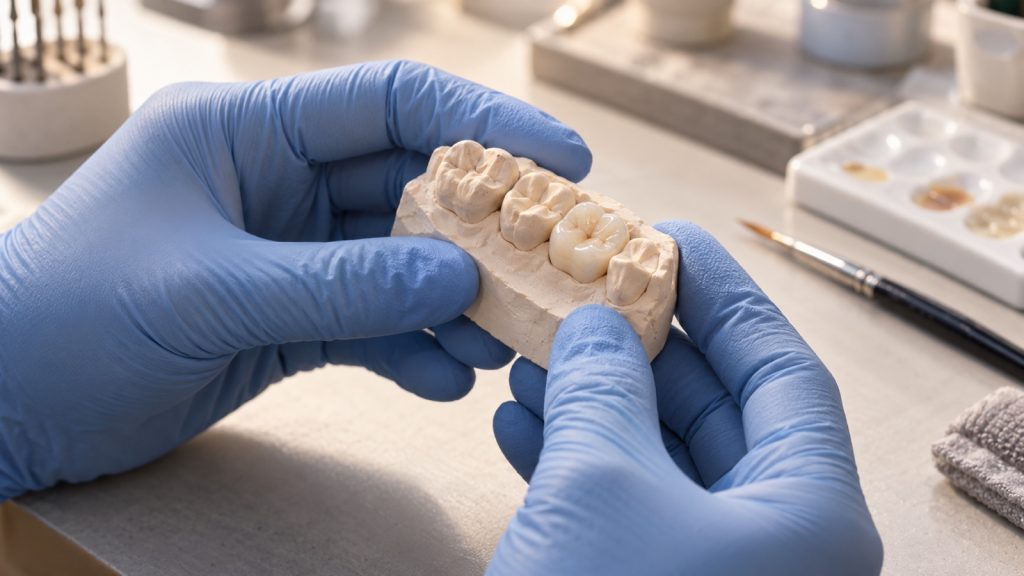
Inlays and onlays are indirect restorations—they are built to repair decayed or damaged teeth. An inlay is inserted into the chewing surface of the tooth. An onlay extends over one or more cusps, the raised points on the chewing surface. Both can restore your tooth when it might not be best to do a filling or a crown.
When deciding between onlays and inlays, your dentist considers how much healthy tooth structure is left and what pattern of decay or damage has occurred as well as your bite. Choosing one over the other is not just opting for a bigger filling material. Your dentist must decide if there is enough tooth strength to support the restoration you need and how much coverage of your natural tooth will keep your tooth strong.
How inlays and onlays differ from fillings and crowns
Made to fit your prepared tooth
A filling is moulded into place while you’re in the dental chair. An indirect restoration, like an inlay or onlay, is crafted elsewhere (typically a lab) and bonded into place. An inlay goes within the cusps. An onlay adds protection by covering a missing or damaged cusp. Crowns cover more of the tooth, such as its sides.
Each type of dental restoration serves a purpose. Sometimes an onlay is ideal for saving tooth structure when a crown is unnecessary. But leaving too little healthy tooth in place to support the restoration won’t do your tooth any good. Your dentist aims to preserve as much of your natural tooth as possible while protecting the tooth.
When is an inlay or onlay recommended?
Decay, a broken cusp or a failing restoration
If a tooth has a large area of damage it may require more than a simple direct filling. An onlay may be recommended if one or more cusps are weak or broken away, but enough healthy tooth structure remains to provide support for a partial-coverage restoration.
Just because there is a large filling present doesn’t mean it should be replaced. Dentists look for signs of new decay, fracture, leakage or loss of support when judging the condition of an existing filling. Age is not a reason to replace a filling that is sound. Sometimes just the defective area can be removed and repaired rather than replacing the entire filling.
When another treatment may be more appropriate
Crowns or another treatment option may be recommended if there is extensive damage and a crown will provide better protection of the tooth. Deep decay or cracks which involve the dental pulp will need to be evaluated to see if root canal treatment is necessary. If a tooth can’t be reliably restored, your dentist will discuss extraction and replacement with you.
Pain alone does not indicate the type of restoration you need. Even when teeth aren’t painful, they may be damaged. It is important to provide information about sensitivity to temperature and pain with biting, as well as any chipped or loose fillings when making your dental appointment.
Ask your dentist to show you on an illustration what is damaged and what healthy tooth structure can be preserved. Ask why the recommended restoration design is the best choice for your tooth. Having the options of a direct filling, a partial-coverage restoration or a crown explained to you may help you understand your treatment options. Cosmetic concerns with an older restoration are just one factor that is considered along with function and health of the remaining tooth.
Materials and treatment steps
Inlays and onlays can be made from ceramic, a dental gold alloy or specially designed composite material. Tooth-coloured materials are available which can match the shade of the rest of the tooth. The choice of material depends on how much space there is, your bite, the design of the restoration and other clinical factors. There is no single material that works best in all situations or that cannot be damaged.
Preparing and fitting the restoration
The dentist will examine your tooth and explain the proposed treatment plan, alternatives, and how much you can expect to pay. The tooth may be numbed with local anaesthetic before preparation begins. Decayed tooth material and old defective restoration material are removed as required. Next, the tooth is prepared for the planned restoration. This involves carefully shaping the remaining tooth structure and taking an impression or digital scan so that the inlay or onlay can be fabricated to fit.
Restorations made at a laboratory usually require another appointment to fit them. During this time you will probably have a temporary restoration to protect your tooth. Some dental offices take a different approach to fabrication. There are benefits to each and your dentist should explain what options are available to you. Ask how many visits will be required and how you can care for your tooth with a temporary restoration before you leave; do not assume same-day service is provided. When you return to have the restoration fitted, the dentist will check its fit, contact with adjacent teeth and your bite. They will then secure it in place using the appropriate bonding or cementing method. They will provide instructions on eating and cleaning.
Ask your dentist what will happen if, after looking at the damaged area, your dentist decides that the original plan needs changing. Decay or cracks don’t always show up until treatment has begun, at which point the dentist may need to modify the treatment plan or discuss alternatives with you.
Caring for your tooth between and after visits
Until your permanent restoration is placed, follow any instructions provided by your dentist or dental professional regarding avoiding hard or sticky foods and excessive chewing with that tooth. If your temporary filling or repair comes loose or falls out, call the office. Do not use household glue to seal it in place or attempt to adjust it yourself.
Brush twice daily with fluoride toothpaste and clean between your teeth after the final restoration is placed. Unlike a natural tooth, your restoration will not develop decay. However, new decay can occur on the remaining tooth structure around the margins of your restoration. Routine review by the dental team is important to monitor both the repair and supporting tooth tissue.
Avoid chewing ice and using teeth to tear open packages. Let your dentist know if you clench or grind your teeth. They may suggest a protective appliance to protect your teeth. Inlays and onlays can chip or wear down over time. They may loosen or fracture and there is no guaranteed lifespan. Your care needs and potential for repair should be discussed before treatment is started.
If you notice a bite that is too high, continued sensitivity, pain or swelling that does not go away or if your restoration becomes loose, call and we can evaluate the problem. Do not hesitate to call if symptoms are persisting or worsening. Waiting until your next routinely scheduled appointment could allow a minor problem to become worse.
Discuss repair options for a damaged tooth
At Vibrant Square Dental we offer restorative dental care. If you have damaged a tooth or filling, please call our Vaughan office. We can assess the tooth and discuss what repair options are appropriate and available. The first step in restoring a damaged tooth is knowing the condition of the tooth.